FPSC CSS General Science & Ability Guide
Compare sellers
| Seller | Condition | Delivery | Price | |
|---|---|---|---|---|
D Dogar Brothers Lahore | New | 2–5 days Courier paid on delivery | Rs 3,200 |
More in CSS and PMS
About FPSC CSS General Science & Ability Guide
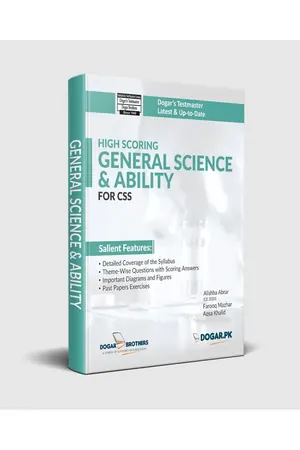
High Scoring FPSC CSS General Science and Ability Preparation Book presents comprehensive information about the FPSC CSS syllabus for General Science and…
High Scoring FPSC CSS General Science and Ability Preparation Book presents comprehensive information about the FPSC CSS syllabus for General Science and Ability. It can be a significant tool for students preparing for competitive exams.
High Scoring FPSC CSS General Science and Ability Preparation Guide:
Salient Features:
- Detailed Coverage of CSS Syllabus
- Theme-wise Questions with Scoring Answers
- Important Diagrams and Figures required for CSS General Science and Ability
- FPSC CSS Past Paper-based Exercises
Table of Contents
Part A – General Science
I. Physical Science
a. Constituents and Structure: – Universe, Galaxy, Light Year, Solar System, Sun, Earth, Astronomical System of Units. 1
• Describe different methods to estimate the age of Universe. 1
• How do galaxies evolve? Give a brief account on the interaction of galaxies. 2
• What is the importance of the Milky Way? What is the composition of planets in our solar system? 3
• Describe the composition of the Sun. 4
• Describe different layers of Earth’s atmosphere. 6
• Write a brief note on tectonic plates. 8
• How are quantities measured in astronomy? 9
b. Process of Nature:- Solar and Lunar Eclipses, Rotation and Revolution, Weather Variables (Global Temperature, Pressure, Circulation, Precipitation, Humidity) and Weather Variations. 10
• Differentiate between the occurrence of Solar and Lunar Eclipse. 10
• Briefly explain what effects are produced due to rotation and revolution of Earth? 11
• What is a mirage? Describe in detail the creation of mirage. 11
• Explain the formation of Lunar Eclipse. 13
• What do you understand by Global Wind and Pressure patterns? Also explain wind and pressure features at higher altitude. 13
• What is circulation? How does it affect the weather? 15
• How does humidity influence other weather variables? What are the different ways to express humidity? 16
• How is global temperature changing and affecting our ecosystem? 17
• How does precipitation take place? 18
• Explain weather variations. 19
c. Natural Hazards and Disasters:- Earth Quake, Volcanic Eruption, Tsunami, Floods, Avalanche, Travelling Cyclone (Tropical Cyclone, Middle Latitude Cyclone and Tornadoes), Drought, Wildfire, Urban Fire. Disaster Risk Management. 20
• What is a tsunami? How the tsunamis are generated and what are their characteristics? 20
• What is an Earthquake? Discuss Richter Scale in this context. What was the intensity of the Earthquake in Pakistan dated 26 October 2005 and where was the locus? 20
• Describe the different causes of Tsunami. Is there any difference between a Tsunami and tidal wave? Name the worst Tsunami ever recorded. 21
• What is the most dangerous part of a hurricane and how do cyclones affect humans? 21
• On 7th April 2012 an Avalanche hit a Pakistan military base in Gayari sector trapping 140 soldiers and civilians under deep snow, what is avalanche; describe its four types with focus on most dangerous type? 22
• World’s largest earthquake was assigned a magnitude of 9.5 by the United States Geological Survey on 22 May 1960 in southern Chile Valdivia. What do you know about earthquakes? Also explain shallow-focus and deep-focus earthquakes. 24
• Differentiate between Middle Latitude Cyclones and Tornadoes. 25
• Write a note on cyclones. How do they form? Also explain typhoons. 25
• The largest recorded volcanic eruption occurred in Indonesia in 1815 which lead to calamity, starvation, and deaths at huge levels. What are volcanic eruptions? What are its three main types? 26
• Drought is a natural disaster. What do you know about it? 27
• How do urban fires and wildfires occur and what is the difference between them? 28
• How can the risk of natural disasters be managed? Explain briefly the points to be considered while coping up with the disaster. 29
d. Energy Resources:- Sources of Energy (Renewable i.e. LED Energy, Solar Energy, Wind Energy and Non-Renewable Energy), conservation and its sustainable use. 30
• Most of the household appliances utilize ‘DC’, then why do we generate ‘AC’ at the power stations? 30
• Differentiate between the Renewable and Non Renewable sources of energy giving examples of each. 30
• Differentiate between the renewable and non-renewable energy sources, briefly explain Geothermal Energy and Hydro Electricity. 31
• What are the different forms in which energy exists? 32
• How can energy be conserved? 33
• What is the mechanism of LED? What are its uses that make it a choice in modern age? 33
• Write a brief note on non-renewable energy conservation and its sustainable use. 34
• How do renewable energy resources replace conventional fuels? 34
• What are the different ways to get benefits from solar energy? 35
• What do you know about wind energy and its harnessing? Also describe wind farm. 36
e. Atomic Structure, Chemical Bonding, Electromagnetic Radiations. 37
• Explain the shape of water molecule with the help of Molecular Orbital Theory, also draw its orbital diagram. 37
• What are the gamma rays? Explain their applications. 37
• Explain the terms Dark Energy and Dark Matter. 38
• Define the term Black Hole. What’s expected inside it? 38
• How can the Sun have such a strong gravitational field if it’s made up of gases? 39
• Explain Electromagnetic spectrum and its components in detail with ranges. 39
• What do you know about UV rays? 41
• What are X rays? Explain its uses. 41
• Write a note on infrared rays. 42
• Write a brief note on chemical bonding. 42
• Differentiate between covalent and ionic bonding. 43
f. Modern Materials/Chemicals:- Ceramics, Plastics, Semiconductors. Antibiotics, Vaccines, Fertilizers, Pesticides. 44
• What are vaccines? Classify these and discuss DNA vaccines in detail. 44
• Why should the excessive use of chemical fertilizers be avoided? 45
• What is the difference between vaccines and anti-biotics? How do vaccines and antibiotics contribute to the health? 45
•
Book details
| Language | English |
|---|
Ratings and reviews
No reviews yet. Reviews come only from customers who bought and received this book.