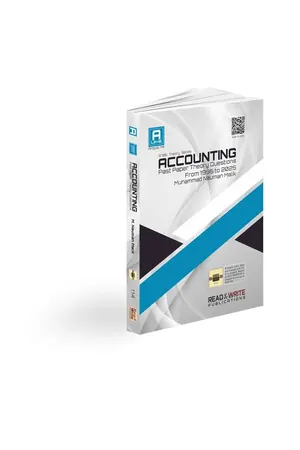
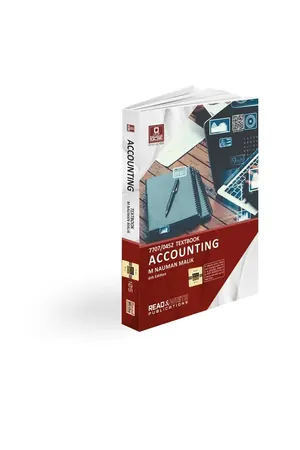
105 accounting O Level: theory and Practice (2027-2029)
Only 1 left from this seller
Compare sellers
| Seller | Condition | Delivery | Price | |
|---|---|---|---|---|
R Readings Lahore | New | 2–5 days Courier paid on delivery | Rs 1,960 |
More by Muhammad Nauman Malik
About 105 accounting O Level: theory and Practice (2027-2029)
105 Accounting O Level Theory and Practice | Read & Write Publications.
105 Accounting O Level Theory and Practice | Read & Write Publications. TABLE OF CONTENTS
PREFACE (105 Accounting O Level Theory and Practice) CHAPTER 1A BOOKKEEPING AND ACCOUNTING 1A.1 BRANCHES OF ACCOUNTING 1 A.2 ACCOUNTING EQUATION 1A.2.1 Assets 1A.2.2 Liabilities 1A.2.3 Equity 1A.2.4 Drawings 1A.2.5 Treatment of transactions relating to owners 1A.2.6 The Dual Aspect Concept and the Accounting Equation 1A.3 TRANSACTION 1A.3.1 Cash Transactions 1A.3.2 Credit Transactions 1A.4 STATEMENT OF FINANCIAL POSITION 1A.4.1 Statement of Financial Position (Horizontal Style) 1A.4.2 Statement of Financial Position (Vertical Style) REVIEW QUESTIONS
CHAPTER 1B ACCOUNTING FOR ASSETS, LIABILITIES AND CAPITAL 1B.1 EVOLUTION OF BOOK KEEPING 1B.2 ACCOUNT 1B.3 ”T” ACCOUNT 1B.4 RULES OF DEBIT AND CREDIT 1B.5 THREE-COLUMN LEDGER ACCOUNT (RUNNING BALANCE METHOD) 1B.6 LEDGER 1B.7 DOUBLE-ENTRY RELATING TO ASSETS AND LIABILITIES 1B.7.1 EXAMPLE 1B.8 BALANCING OF AN ACCOUNT 1B.8.1 When should accounts be balanced? 1B.9 TRIAL BALANCE 1B.9.1 Uses of a Trial Balance 1B.9.2 Why is it Necessary for a Trial Balance to ‘Balance’? 1B.9.3 Trial Balance – An aid to Financial Statements 1B.10 HOW CAN LEDGER ACCOUNTS BE KEPT DIGITALLY? REVIEW QUESTIONS
CHAPTER 1C ACCOUNTING FOR GOODS 1C.1 INVENTORY OF GOODS 1C.2 BOOKKEEPING FOR INVENTORY OF GOODS 1C.3 WHY INVENTORY ACCOUNT DOES NOT INCLUDE PURCHASES AND SALES OF GOODS 1C.4 PURCHASES 1C.4.1 Cash Purchases 1C.4.2 Credit Purchases 1C.5 SALES 1C.5.1 Cash Sales 1C.5.2 Credit Sales 1C.6 PURCHASES RETURNS (RETURN OUTWARDS) 1C.7 SALES RETURNS (RETURNS INWARDS) 1C.8 TRADING SECTION OF INCOME STATEMENT 1C.9 CLOSING OF INCOMES AND EXPENSES 1C.10 CLOSING INVENTORY 1C.11 OPENING INVENTORY REVIEW QUESTIONS
CHAPTER 1D ACCOUNTING FOR INCOMES AND EXPENSES 1D.1 INCOMES 1D.2 EXPENSES 1D.3 DOUBLE-ENTRY FOR EXPENSES AND INCOMES (REVENUES) 1D.4 BOOKKEEPING FOR INCOMES AND EXPENSES 1D.5 CALCULATION OF NET PROFIT 1D.6 CLOSING OF INCOMES AND EXPENSES REVIEW QUESTIONS
CHAPTER 2 BOOKS OF PRIME ENTRY 2.1 ADVANTAGES OF MAINTAINING BOOKS OF ORIGINAL ENTRY 2.2 COMPONENTS OF BOOKS OF ORIGINAL ENTRY 2.3 SALES JOURNAL 2.3.1 Posting from the Sales Journal to the Ledger 2.3.2 Trade Discount 2.3.3 Sales on Credit Card 2.4 PURCHASES JOURNAL 2.4.1 Posting from the Purchases Journal to the Ledger 2.5 RETURN INWARDS JOURNAL 2.5.1 Posting from the Returns Inwards Journal to the Ledger 2.6 RETURN OUTWARDS JOURNAL 2.6.1 Posting from the Returns Outwards Journal to the Ledger 2.7 GENERAL JOURNAL 2.8 CASH BOOK 2.9 PERSONAL LEDGERS 2.10 GENERAL LEDGER REVIEW QUESTIONS
CHAPTER 3 CASH BOOK & PERRT CASH BOOK 3.1 TWO-COLUMN CASH BOOK 3.2 FOLIO COLUMNS 3.3 DISHONOURED CHEQUES 3.4 CONTRA ENTRIES 3.5 BALANCING OF CASH AND BANK COLUMNS 3.6 CASH DISCOUNTS 3.6.1 Why are cash discounts offered? 3.7 THREE-COLUMN CASH BOOK 3.8 NATURE OF DISCOUNTS COLUMNS 3.9 CASH BOOK IN RECENT TIMES 3.10 PETTY CASH 3.11 PETTY CASH BOOK 3.12 IMPREST SYSTEM 3.12.1 Advantages Of the imprest system 3.13 HOW T OAPPLY THE IMPREST SYSTEM 3.14 THE BENEFITS AND LIMITATIONS OF KEEPING CASH AT THE BUSINESS PROPERTY REVIEW QUESTIONS
CHAPTER 4 BANK RECONCILIATION 4.1 DIFFERENCE BETWEEN BANK STATEMENT AND CASH BOOK 4.2 REASONS FOR DIFFERENCE BETWEEN CASH BOOK AND BANK STATEMENT BALANCE 4.2.1 Items in the Bank Statement but not in the Cash Book 4.2.2 Items in the Cash Book but not in the Bank Statement 4.3 BANK RECONCILIATION STATEMENT 4.4 STEPS FOR PREPARING A BANK RECONCILIATION STATEMENT 4.5 USES OF BANK RECONCILIATION STATEMENT 4.6 IMPACT OF DIGITAL TRANSACTIONS ON BANK RECONCILIATION REVIEW QUESTIONS
CHAPTER 5 ACCOUNTING FOR NON-CURRENT ASSET 5.1 DEPRECIATION 5.2 CAUSES FOR DEPRECIATION 5.3 FACTORS FOR CALCULATING DEPRECIATION 5.3.1 The Original Cost of Asset 5.3.2 The Estimated Useful Economic Life 5.3.3 The Approximate Residual Value 5.4 CHARACTERISTICS OF DEPRECIATION 5.5 METHODS FOR CALCULATING DEPRECIATION 5.5.1 Revaluation Method 5.5.2 Straight Line Method or Original Cost Method 5.5.3 Reducing Balance Method 5.6 ANNUAL DEPRECIATION UNDER REDUCING BALANCE & STRAIGHT LINE METHODS 5.7 DISTINCTIVE FEATURES OF STRAIGHT LINE AND REDUCING BALANCE METHOD 5.8 DIFFERENCE BETWEEN DEPRECIATION AND PROVISION FOR DEPRECIATION 5.9 DEPRECIATION POLICIES 5.10 DEPRECIATION ACCOUNTING 5.11 DEPRECIATION AND ACCOUNTING CONCEPTS REVIEW QUESTIONS
CHAPTER 7 INVENTORY VALUATION 7.1 COST 7.2 NET REALISABLE VALUE 7.3 BASIS FOR INVENTORY VALUATION 7.4 INVENTORY VALUATION AND ACCOUNTING CONCEPTS 7.5 SEPARATE VALUATION OF INVENTORY ITEMS 7.6 EFFECTS OF ERRORS IN VALUING INVENTORY REVIEW QUESTIONS
CHAPTER 8 CAPITAL AND REVENUE EXPENDITURE AND RECEIPTS 8.1 TREATMENT OF CAPITAL AND REVENUE ITEMS IN FINANCIAL STATEMENT 8.2 DISTINCTION BETWEEN CAPITAL AND REVENUE EXPENDITURES 8.2.1 Expenditures for Acquisition of a Non-current asset 8.2.2 Expenditures for Improving Efficiency /Capacity of a Non-current asset 8.2.3 Expenditure at the Initiation of Business 8.2.4 Expenditure on Extension of Business 8.2.5 Expenditures to Increase the Useful Life of an Asset 8.2.6 Expenditures of Abnormal Amounts 8.3 APPLICATION OF MATERIALITY CONCEPT 8.4 DIFFERENCE BETWEEN CAPITAL AND REVENUE RECEIPTS 8.4.1 Revenue Receipts 8.4.2 Capital Receipts 8.5 EFFECTS OF WRONG TREATMENT OF CAPITAL AND REVENUE ITEMS REVIEW QUESTIONS
CHAPTER 9 CORRECTION OF ERRORS 9.1 TYPES OF ERRORS 9.1.1 Errors Not Affecting Agreement of Trial Balance 9.1.2 Errors Affecting Agreement of Trial Balance 9.2 SUSPENSE ACCOUNT 9.3 EFFECT ON PROFIT OF CORRECTING ERRORS 9.4 EFFECTS ON STATEMENT OF FINANCIAL POSITION OF CORRECTING ERRORS REVIEW QUESTIONS
CHAPTER 10 CONTROL ACCOUNTS 10.1 CONTROL ACCOUNTS IN CAMBRIDGE ORDINARY LEVEL SYLLABUS 10.2 THE FORMAT OF CONTROL ACCOUNTS 10.3 BOOKS OF PRIME ENTRY AS SOURCES OF CONTROL ACCOUNTS ENTERIES 10.4 CONTRA ENTRY 10.5 TWO BALANCES OF CONTROL ACCOUNTS 10.5.1 Reasons for Having Two Balances of a Control Account 10.5.2 Treatment of Two Balances in the Statement of Financial Position 10.6 BENEFITS OF OFFERING CASH DISCOUNTS 10.7 EFFECTS OF CHARGING INTEREST ON OVERDUE BALANCES OF CUSTOMERS 10.8 ADVANTAGES OR USES OF CONTROL ACCOUNTS 10.9 IMPACT OF DIGITAL ACCOUNTING ONN CONTROL ACCOUNTS REVIEW QUESTIONS
CHAPTER 11 OTHER PAYABLES AND OTHER RECEIVABLES 11.1 Matching Costs and Revenues 11.2 Accruals 11.2.1 Accrued Expenses (Other Payables) 11.2.2 Accrued Incomes (Other Receivables) 11.3Prewvyments 11.3.1 Prepaid Expenses [Other Receivables) 11.3.2 Pre-received Incomes/Incomes in Advance 11.4 Treatment of Opening Accruals or preravments 11.5 Application of Matching Concept by Using Accruals and Prepayments REVIEW QUESTIONS
CHAPTER 12 SOLE TRADERS 12.1 SOLE TRADER 12.1.1 Advantages of Operating as a Sole Trader 12.1.2 Disadvantages of Operating as a Sole Trader 12.2 Need for Statement of profit or loss 12.3 Uses of statement of profit or loss 12.4 Carriage Inwards 12.5 Carriage Outwards 12.6 Financial Statements – An important consideration 12.7 Accounting Period 12.8 Drawings 12.9 Assets 12.9.1 Non-Current Assets 12.9.2 Current Assets 12.10 LIABILITIES 12.10.1 Current Liabilities 12.10.2 Non-Current Liabilities 12.11 Cash and Accrual Basis of Accounting 12.12 Need for Adjustments 12.13 Types of Adjustments 12.13.1 Inventory at Year-End 12.13.2 Closing Inventory in Trial Balance 12.13.3 Drawings by Owner 12.13.4 Other Receivables and Payables 12.13.5 Depreciation 12.13.6 Irrecoverable debts 12.13.7 Allowance for irrecoverable debts 12.14 The Versatility of Sole Trader Businesses 12.15 Calculation of Profits for Service Businesses 12.16 Calculation of Profits for a Trading and a Service Business REVIEW QUESTIONS
CHAPTER 13 PARTNERSHIPS 13.1 The Versatility of Partnerships 13.2 Advantages and Disadvantages of the Partnership 13.3 Partnership Agreement 13.3.1 Contents of Partnership Agreement 13.4 Provision of Partnership Act 1890 in the Absence of Partnership Deed 13.5 Financial Statements of a Partnership 13.5.1 Appropriations of Profit 13.5.
Book details
| Author | Muhammad Nauman Malik |
|---|---|
| Publisher | Read & Write Publications |
| Language | English |
| Pages | 392 |
| Format | Paperback |
| ISBN | 9789697440054 |
Ratings and reviews
No reviews yet. Reviews come only from customers who bought and received this book.